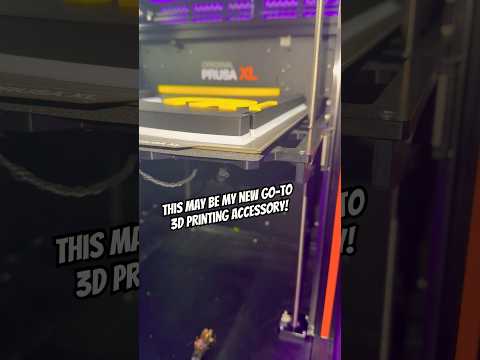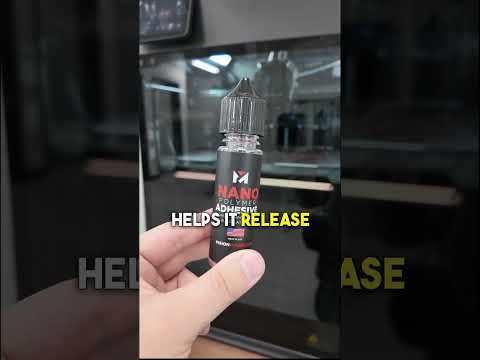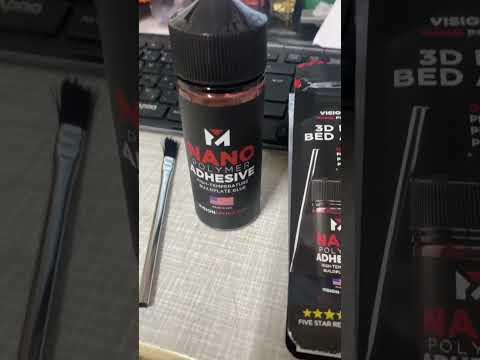

Glue stick and hairspray let go of high-temp polymers. NPA doesn't. Brush on a thin coat, heat the plate past 60ºC, and your first layer stays put -- on PEEK, ULTEM™, PPSU, nylon, PLA and almost every filament we've tested.
There's nothing worse than starting a long print, coming back five hours later, and finding the first layer let go in hour one. The printer has been extruding into open air ever since.
That's the problem we kept hitting with high-temp thermoplastics. Glue stick wasn't holding, so in January 2018 we went straight to adhesive-specialized material scientists. We spent almost a year with them formulating something that could.
The result is Nano Polymer Adhesive, formulated in Costa Mesa, California. It holds against pull forces over 20,000 PSI, the kind of grip it takes to keep PEEK and PEI down while they cool and contract.
It works on everyday filaments too. On PLA and PETG one coat lasts 50+ prints, and a bottle holds 300+ coats for a 7x7in plate.
What you get
Holds PEEK, PEI and other high-temp polymers
Better grip than glue stick or hairspray, without the mess
Works on glass, carbon fiber, PEI, FR4 and more
Easy to clean off and re-apply
Works on PLA, ABS and nylon too
Made from safe, non-toxic, organic compounds
Can even refresh Stratasys® build sheets
How to use it
Six steps. You already do most of them.
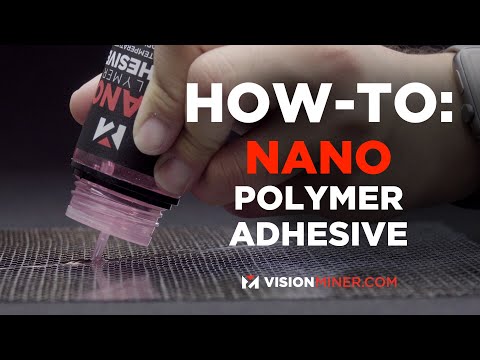
No special prep and no extra-close z-offset. Brush it on, heat the plate, print.
50+
Prints per coat
On PLA and PETG before you re-apply
300+
Coats per bottle
Based on a 7x7in build plate
1
Clean the plate
Water, Windex or alcohol.
2
Brush it on
A thin, even coat over the build area.
3
Heat the plate
NPA activates above 60ºC.
4
Set your first layer
Normal z-offset. No need to squash it into the plate.
Carbon fiber, glass fiber, stone and glitter filled filaments, Flex PLA, Soft PLA
Build surfaces
Borosilicate and ceramic glass
Uncoated Creality glass
Carbon fiber plates
Garolite, FR4, PCB board, fiberglass
PEI, BuildTak™, WhamBam, flex plates
Kapton tape
Won't stick
PP (polypropylene) and POM (Delrin). PP doesn't really stick to anything, adhesive or not.
How it compares
NPA vs. Magigoo, glue stick and the rest
Most bed adhesives are made for PLA, PETG and ABS, and they do that job fine. NPA was made for PEEK and ULTEM on a hot plate, and it handles PLA as well. Here's how the common options line up, going by what each maker publishes.
Adhesive
Format
What the maker lists it for
PEEK / ULTEM
Nano Polymer Adhesive
Vision Miner
Format
Brush-on liquid
What the maker lists it for
PLA through PEEK, PEKK, ULTEM, PPSU, nylon, PC, TPU and carbon fiber filled. One formula for all of it.
PEEK / ULTEM
Yes
Magigoo
Original, PA, PC, Flex, Pro HT
Format
Pen applicator
What the maker lists it for
A separate formula per material family. Original covers PLA, ABS, PETG and HIPS.
PEEK / ULTEM
Pro HT only, PEEK on beds up to 150ºC
Layerneer Bed Weld
Format
Liquid
What the maker lists it for
ABS, ASA, PLA and PETG on glass. Not recommended for nylon, PP or TPU 95A.
PEEK / ULTEM
Not listed
3DLAC
Format
Aerosol spray
What the maker lists it for
PLA, ABS and PETG. Nylon gets its own spray, 3DNylon.
PEEK / ULTEM
Not listed
Dimafix
Format
Spray or pen
What the maker lists it for
Heat-activated: grips above roughly 60-65ºC, releases as the bed cools. Common and engineering filaments.
PEEK / ULTEM
Not listed
Bambu Lab Liquid Glue
Format
Liquid applicator
What the maker lists it for
PLA, ABS and PETG on Bambu Lab plates. Also used as a release layer for PETG and TPU.
PEEK / ULTEM
Not listed
Elegoo Liquid Adhesive
Format
Liquid
What the maker lists it for
PEI build plates, like the Centauri Carbon's.
PEEK / ULTEM
Not listed
Glue stick
PVP or PVA
Format
Stick
What the maker lists it for
PLA and PETG. Usually a fresh coat every print or two.
PEEK / ULTEM
No
Hairspray
Format
Aerosol
What the maker lists it for
PLA and ABS. Overspray ends up on the rest of the printer.
PEEK / ULTEM
No
NPA vs. Magigoo
Magigoo makes a different bottle for each material family, and Pro HT, its high-temp version, is built around PEEK on beds up to 150ºC. NPA is one bottle from PLA to PEEK. In a shop that runs a bit of everything, that's one bottle on the shelf instead of five.
NPA vs. glue stick
Glue stick is cheap, and for PLA it works. It's also a new coat every print or two, and it lets go of high-temp polymers. One coat of NPA lasts 50+ prints on PLA and PETG.
NPA vs. Bambu Lab Liquid Glue
Bambu's glue is made for PLA, ABS and PETG on Bambu plates. NPA works on those PEI plates too, and it also holds nylon, PC, carbon fiber filled and the high-temp polymers.
NPA vs. Layerneer Bed Weld
Bed Weld is designed for glass, and Layerneer doesn't recommend it for nylon or TPU 95A. NPA handles both, and works on glass, garolite, carbon fiber, PEI and Kapton.
NPA vs. Dimafix
Both are heat-activated: they grip while the bed is hot and let go as it cools. Dimafix kicks in around 60-65ºC, NPA at 60ºC+. The difference is the top end. NPA holds PEEK, PEKK and ULTEM.
NPA vs. 3DLAC and hairspray
Sprays are fast. They also land on your rails, bed clips and the inside of the enclosure. NPA brushes on where you want it and nowhere else.
Comparison is based on each maker's published product listings as of October 2026. If something's changed, tell us at contact@visionminer.com and we'll fix it. Magigoo, Layerneer, Bed Weld, 3DLAC, Dimafix, Bambu Lab and Elegoo are trademarks of their owners. Vision Miner isn't affiliated with any of them.
Most printers ship with PEI or textured plates now, but if you're on glass, when you pull the part depends on how hot you're printing.
High temp: pull it hot
Remove the part as quickly as you can, while the plate and part are still HOT. High-temp polymers contract fast as they cool, and a part can crack glass in under 30 seconds. That's why we make carbon fiber build plates for high-temp work.
Low temp: let it cool
Wait for the plate to cool. PLA and PETG usually pop off on their own. If a part is holding on, drip a little water around the base and it'll release.
Caution
ABS and PETG can chip glass, adhesive or not
ABS contracts fast as it cools. Print it on Kapton tape, PEI or another protective sheet over the glass.
Get your first layer right. A first layer smashed into the plate can break glass by itself. With NPA you don't need an extra-close z-offset.
Level properly and pull high-temp parts quickly. High-performance polymers cool faster than glass.
This was well documented long before our adhesive existed, and we can't cover broken build plates.