
Carbon & glass fiber filament

Carbon fiber

3D printing

Chopped carbon and glass fiber grades from nylon up to PEEK, PEKK and ULTEM™. Stiffer parts, way less warp, and a lot fewer failed prints.

Shop the lineup

Which one do I need?

Not sure which grade fits your part?

Talk to an engineer ›

Have us print it ›

Data sheets ›

Why add fiber at all

Carbon fiber doesn't make every part stronger

You've probably heard that carbon fiber filament is just for looks. That's partly true. It won't always raise tensile strength, and it can make a part more brittle. Here's what it actually does for you.

01

Stiffness for the weight

Chopped fiber lines up as it goes through the nozzle and adds stiffness along every layer line. The result is a part that flexes a lot less without getting heavier.

02

Way less warp

This is the big one. Warping is what ruins PEEK and PEI prints, cracks build plates and wrecks your dimensions. Add fiber and most of that goes away. CF-PEEK can feel 10x easier to print than straight PEEK.

03

Static control

Carbon changes the part's electrical resistivity, which matters for parts that sit around electronics or handle powders. Check the data sheet for the exact grade before you count on it.

A single carbon fiber filament next to a human hair, under an electron microscope.

Chopped vs. milled

Ask what kind of fiber, not how much

Milled carbon is short, close to a powder. It's cheap and it adds some stiffness. Chopped carbon starts as 6mm strands. After compounding and extrusion it ends up around 200–300 µm long, and those strands line up in the nozzle.

Grade matters too. Aerospace-grade fiber is thinner and stiffer than industrial grade. Our PEEK and PEI+CF use aerospace-grade carbon. The nylons use industrial grade. All of them are chopped.

Half the fiber, 40% more stiffness.

No carbon fiber

1,950 MPa


20% milled carbon fiber

6,000 MPa


10% chopped carbon fiber

8,500 MPa


Tensile modulus of the same base polymer. Numbers courtesy of Matt Howlett at 3DXTech.

How carbon fiber filament is made

Chopped, sheared, then lined up

Diagram of a compounding extruder: chopped carbon fiber goes in with polymer pellets, the screw shears it to 200 to 300 microns, and the flow through the die lines the fibers up in the filament.

Which one do I need?

Start with your temperature and your printer

How hot the part runs decides the polymer. What your printer can reach decides whether you can print it. Fiber comes after that.

Any heated-bed printer

Engineering nylons

to 150°C

HDT

PA6+CF, PA12+CF, Obsidian, PC+CF, PP+CF and PA6+GF30. Jigs, fixtures, brackets, end-of-arm tooling and under-hood parts. This is where most people should start.

You'll need

Hardened nozzle, 240–285°C hot end, 60–110°C bed, a dryer.

See the nylons ›

Heated chamber recommended

High-temp nylon

to 220°C

HDT

HTN+CF is a PPA nylon that holds strength and stiffness up to about 195°C in use. It's a metal-replacement material for parts that see heat, load and chemicals together.

You'll need

Hardened nozzle, 285–315°C hot end, 110–120°C bed, 80–120°C chamber.

See HTN+CF ›

High-temp printer

PEEK, PEKK & ULTEM™

240–260°C

continuous use

Flame-rated, autoclavable and chemical resistant. Aerospace, oil & gas, medical and semiconductor parts. Fiber is what makes these printable without fighting warp all day.

You'll need

Hardened nozzle, 365–450°C hot end, 120–160°C bed, a hot chamber. Like the 22 IDEX.

See the ultra grades ›

Need the most heat?

Glass-filled PEEK. At 20% glass, PEEK's heat deflection temperature climbs to about 304°C (579°F). That's near the limit for thermoplastics in general, so it's the pick for your hottest parts.

See PEEK+GF20 ›

Shop the lineup

Every carbon & glass fiber grade we carry

All filaments ›

PEEK, PEKK & ULTEM™

All-metal hot end to 400°C+ · heated bed 120–160°C

PEEK · CarbonX™

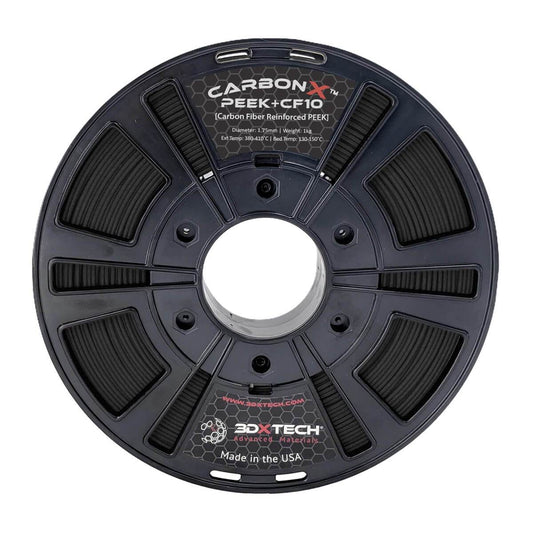
PEEK+CF10

Our go-to PEEK. 10% aerospace-grade chopped carbon makes it far easier to print than straight PEEK. UL94 V-0, autoclavable.

143°C

Tg

280°C

HDT

390–450°C

Nozzle

$345.00

Print settings & data sheet ›

PEKK · CarbonX™

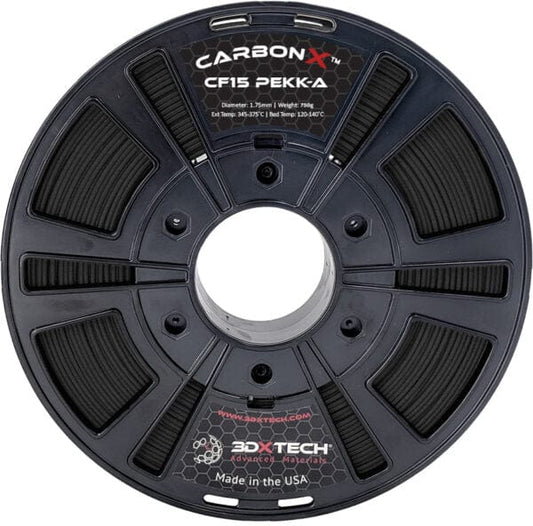
PEKK-A+CF15

Prints cooler than PEEK with a wider window, then beats PEEK once it's annealed. Tg is about 20°C higher. Base resin is V-0.

160°C

Tg

150°C

HDT

345–375°C

Nozzle

$250.00

750g

Print settings & data sheet ›

PEI · CarbonX™

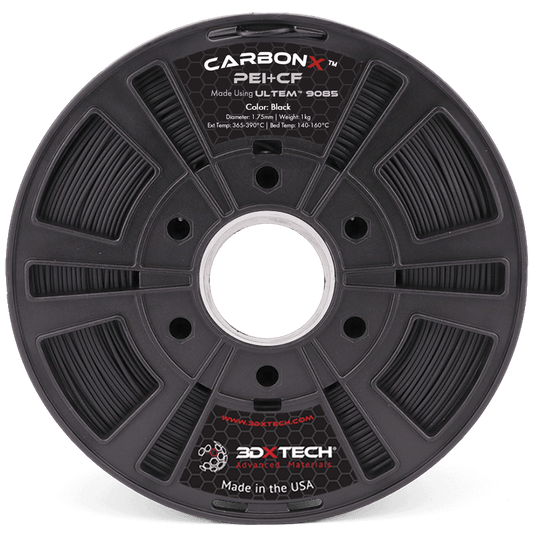
PEI+CF (ULTEM™ 9085)

Real Sabic ULTEM™ 9085 with aerospace-grade carbon. Low smoke, low toxicity, inherently flame resistant. Built for aircraft interiors.

186°C

Tg

165°C

HDT

365–390°C

Nozzle

$195.00

500g

Print settings & data sheet ›

PEEK · FibreX™

PEEK+GF20

Glass instead of carbon, in a natural color. Same PEEK heat and chemical resistance, low warp, and no carbon if your part can't be conductive.

143°C

Tg

260°C

Cont. use

375–450°C

Nozzle

$395.00

Print settings & data sheet ›

PEI · FibreX™

PEI+GF30 (ULTEM™ 1010)

The highest-heat grade on this page. ULTEM™ 1010 with 30% glass. Wants a very hot chamber, but it holds shape like nothing else here.

217°C

Tg

212°C

HDT

370–390°C

Nozzle

$175.00

500g

Print settings & data sheet ›

PEEK · Solvay

KetaSpire® CF PEEK

Solvay's own CF10 PEEK for when your spec calls for the resin maker's filament by name. Runs a hotter bed than the CarbonX™ grade.

140 MPa

Tensile

240°C

Cont. use

390–420°C

Nozzle

$782.34

1kg

Print settings & data sheet ›

Nylons, PC & PP

Most heated-bed printers with a hardened nozzle

PA6 · CarbonX™

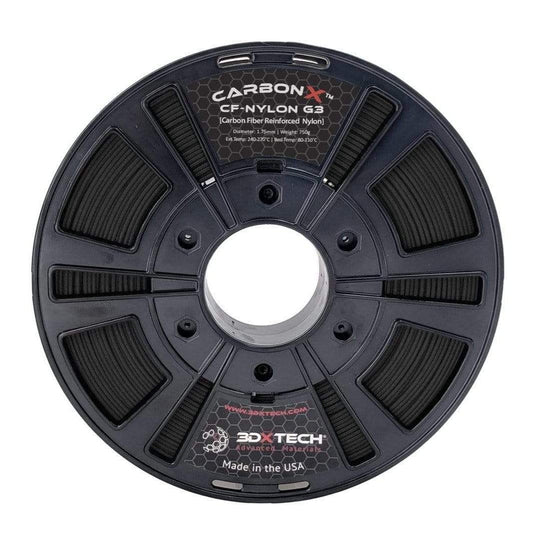
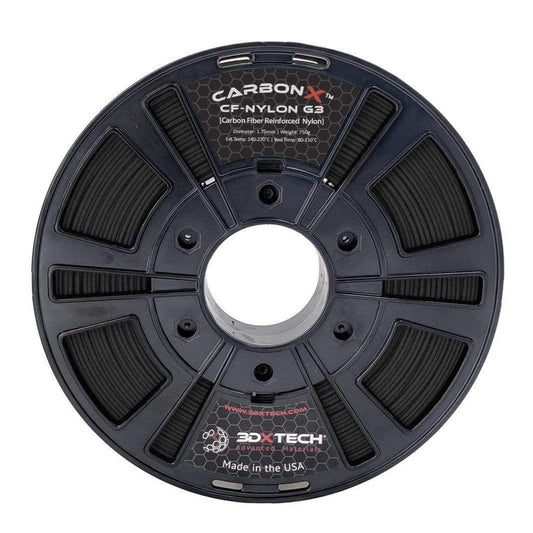
PA6+CF Gen3

Tired of nylon that warps? This is the fix. Semi-aromatic PA6 with high-modulus carbon. Prints on practically any desktop printer with a heated bed.

147°C

HDT

240–270°C

Nozzle

80–110°C

Bed

$62.50

Print settings & data sheet ›

PA6 · Obsidian™ v2

Obsidian PA6+CF

A one-to-one Onyx™ alternative, re-formulated and tested on Markforged FX20, X7, X5, X3, Mark Two and Onyx Pro/One. Runs on any PA6+CF printer too.

Onyx

Drop-in

265–285°C

Nozzle

90–110°C

Bed

$99.99

750g

Print settings & data sheet ›

PA12 · CarbonX™

PA12+CF

Nylon 12 soaks up a lot less moisture than PA6 and shrinks very little. Good chemical resistance. Our pick for tooling that has to hold a dimension.

150°C

HDT

265–285°C

Nozzle

90–110°C

Bed

$135.00

Print settings & data sheet ›

PPA · CarbonX™

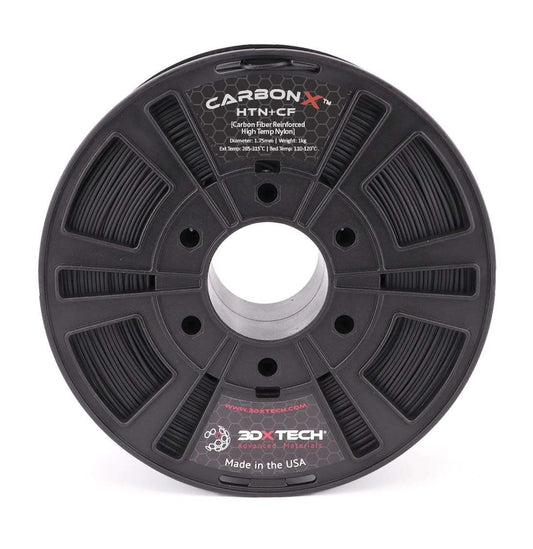
HTN+CF

High-temp nylon (PPA) for metal replacement. Holds load and stiffness up to about 195°C and shrugs off aggressive chemicals.

220°C

HDT

285–315°C

Nozzle

80–120°C

Chamber

$175.00

750g

Print settings & data sheet ›

PC · CarbonX™

PC+CF

Polycarbonate stiffness and heat with a clean matte finish. The new formula dries as low as 80°C, so it's less fussy than the old CF-PC.

147°C

Tg

260–280°C

Nozzle

80–120°C

Bed

$88.00

750g

Print settings & data sheet ›

PA6 · FibreX™

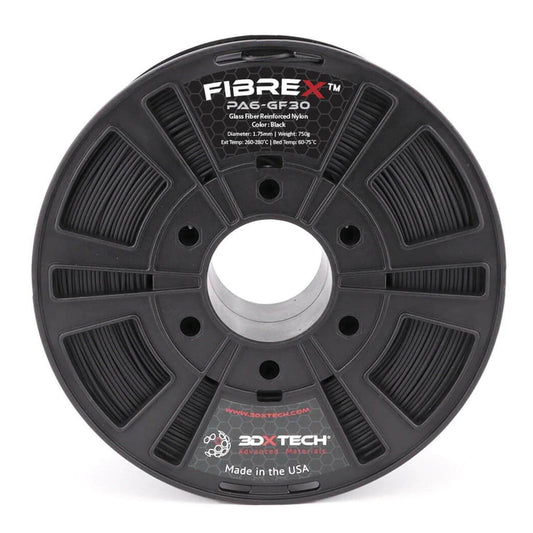
PA6+GF30

An industrial-grade beast. Stiff and strong without going brittle, and it handles fuel, oil and heat to 170°C like under-hood auto parts do.

170°C

In use

260–280°C

Nozzle

60–75°C

Bed

$78.00

750g

Print settings & data sheet ›

PP · CarbonX™

PP+CF

Light, doesn't absorb moisture, and low warp for a polypropylene. A 650g reel is about as much filament as a 1kg reel of ABS.

0%

Moisture

220–250°C

Nozzle

23–60°C

Bed

$78.00

650g

Print settings & data sheet ›

Bundles

Try several grades and get the adhesive in the same box

Best way to start

Carbon fiber filament bundle

Four CF grades across nylon, PC and PP, plus the adhesive to keep them on the plate.

CarbonX™ PA6+CF Gen3 · 500g

CarbonX™ PA12+CF · 500g

CarbonX™ PC+CF · 750g

CarbonX™ PP+CF

2× Nano Polymer Adhesive · 120ml

$349.99

Bundle details ›

Nylon only

Carbon fiber nylon bundle

Three CF nylons side by side, including the Onyx™ alternative.

CarbonX™ PA12+CF · 500g

CarbonX™ PA6+CF Gen3 · 500g

Obsidian™ PA6+CF

2× Nano Polymer Adhesive · 120ml

$319.99

Bundle details ›

Before your first spool

Three things every fiber print needs

Fiber eats brass nozzles. Wet nylon pops and strings. High-temp parts let go of the plate. These three take care of it.

Required

Hardened steel nozzle

Carbon and glass chew through brass fast. Once the orifice wears, extrusion goes inconsistent. Use 0.4mm or bigger.

$20.00

For PEEK, PEKK & PEI

Nano Polymer Adhesive

We made it for PEEK in the first place. Holds better than glue stick without the mess, works on glass and carbon plates, and cleans up easily.

$45.00

For every nylon

Vacuum chamber + pump

Nylon pulls water out of the air in hours. Dry it before you print and store it under vacuum after. 5.5 gallon chamber.

$499.00

Chamber + pump

For the ultra grades

A printer that gets hot enough

PEEK and ULTEM™ need a 400°C+ hot end, a 160°C bed and a hot chamber. Most desktop printers can't get there.

See the 22 IDEX ›

Full drying times and temperatures by material: Filament drying guide ›

Print settings

Starting points for every grade

Every printer and slicer is a little different. Start here, then tune.

Data sheets ›

Material

Fiber

Nozzle

Bed

Chamber

Tg / HDT

PEEK, PEKK & ULTEM™

PEEK+CF10

CarbonX™

10% carbon

390–450°C

130–160°C

Recommended

143°C / 280°C

KetaSpire® CF PEEK

Solvay

10% carbon

390–420°C

>200°C

Recommended

Tm 343°C

PEEK+GF20

FibreX™

20% glass

375–450°C

130–160°C

90–145°C

143°C / 304°C

PEKK-A+CF15

CarbonX™

15% carbon

345–375°C

120–140°C

70–140°C

160°C / 150°C

PEI+CF (ULTEM™ 9085)

CarbonX™

Carbon

365–390°C

140–160°C

Recommended

186°C / 165°C

PEI+GF30 (ULTEM™ 1010)

FibreX™

30% glass

370–390°C

120–160°C

90–230°C

217°C / 212°C

Nylons, PC & PP

HTN+CF

CarbonX™

Carbon

285–315°C

110–120°C

80–120°C

125°C / 220°C

PA12+CF

CarbonX™

Carbon

265–285°C

90–110°C

—

— / 150°C

PA6+CF Gen3

CarbonX™

Carbon

240–270°C

80–110°C

—

— / 147°C

Obsidian PA6+CF

Obsidian™ v2

Carbon

265–285°C

90–110°C

Optional

—

PC+CF

CarbonX™

Carbon

260–280°C

80–120°C

—

147°C / —

PA6+GF30

FibreX™

30% glass

260–280°C

60–75°C

—

— / to 170°C in use

PP+CF

CarbonX™

Carbon

220–250°C

23–60°C

—

—

HDT at 0.45 MPa where listed. Values come from each product page and the manufacturer's data sheet. A dash means it isn't published yet.

Shop-floor rules

What we've learned printing fiber every day

0.4mm+

Nozzle size

Hardened steel only. Smaller orifices clog with fiber.

50–60%

Layer height

Of your nozzle diameter. We run 0.2mm layers on a 0.4mm nozzle all day. 0.25mm gives you a little more margin.

0.2mm

Thinnest layer

Go thinner and back pressure builds: jams, clicking drive gears and a notch chewed into the filament.

Dry

Every time

Nylon and PC absorb water. Obsidian wants 90°C for 4 hours if it shows moisture. KetaSpire® wants 150°C for 4.

Built for these materials

22 IDEX v4

We built it for the top half of this page: CF-PEEK, PEKK and ULTEM™.

Independent dual extruders with hot ends that reach PEEK and ULTEM™ temps

Heated chamber and bed for the ultra-performance grades

Print a support material in the second head next to your fiber part

See the 22 IDEX ›

Which printer do I need?

FAQ

Carbon fiber questions

Does carbon fiber make my part stronger?

Stiffer, yes. Stronger, not always. Chopped fiber raises stiffness a lot, but it can lower impact strength and make a part more brittle. The bigger win is dimensional accuracy and a much lower failure rate, especially on PEEK and PEI.

Do I really need a hardened nozzle?

Yes. Carbon and glass fiber are abrasive, and a brass nozzle can wear out within a few spools. Once the orifice opens up, extrusion gets inconsistent. A hardened steel nozzle is $20.

Can I print this on my desktop printer?

The nylons, PC+CF, PP+CF and PA6+GF30 print on most printers with a heated bed and a hardened nozzle. HTN+CF really wants a heated chamber. PEEK, PEKK and ULTEM™ need an all-metal hot end that holds 400°C, a bed up to 160°C and a hot chamber.

Carbon or glass fiber?

Carbon is stiffer and lighter, and it's black. Glass is a bit cheaper, comes in natural, and isn't conductive. If your part sits near electronics or needs to be non-conductive, go glass.

PEEK or PEKK?

If your printer struggles above 400°C, go PEKK-A+CF15. It prints 345–375°C, has a wider window, and after annealing it outperforms PEEK. Go PEEK+CF10 when your spec calls for PEEK by name.

Will Obsidian run on my Markforged?

Yes. Obsidian™ v2 was reworked and tested on the FX20, X7, X5, X3, Mark Two, Onyx Pro and Onyx One as a one-to-one Onyx™ alternative.

Can you print the part for me?

Yes. Send us the file through our 3D print service and we'll print it in any of these materials.

Not sure which grade fits?

Tell us the part, the temperature and the printer. An engineer will tell you what we'd run.

Talk to an engineer ›

Shop the lineup

Shopping cart

Your cart is empty.

Return to shop